Pattern City

February – editing in progress – PATTERN CITY ANIMATION

Videos: go full screen for best experience.

Above: from the section animations from Pattern City – Escape (top) Transformation (bottom)

The novel has been edited but I’m still adapting the text for the silver screen. I started the novel a few years ago. It’s been through a few versions, including an epic poem. Animations for the first sections are exhibited in the current Computer Arts Society ‘Drivers’ exhibition  at British Computer Society London until March 2026. More scenes online soon – Geoff 2/2/2026. For alerts please email geoffdavis5 at gmail com. Thanks for your support.

Geoff Davis at DRIVERS exhibition with animation

Geoff Davis at DRIVERS 2025-2026 CAS exhibition with animation

Geoff Davis Pattern CIty 2025
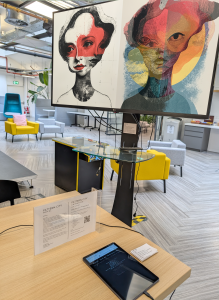
Geoff Davis Pattern CIty & Minimal (tablet on table) – CAS BCS DRIVERS exhibition 2025-2026

Back cover: “When an unnatural disaster strikes, Samantha must navigate a transformed world with her new adopted family and Botz robot companions. Their chance for escape lies in the luxury orbital habitats above – but her decision to leave her volatile son behind with a hacked military robot unleashes chaos that threatens everything.”

Geoff Davis Pattern CIty & Minimal
Geoff Davis Pattern CIty – CAS BCS DRIVERS 2025-2026

The “Drivers” CAS 2025 Exhibition catalogue is available here.

Pattern City (Geoff Davis 2015-2026) extends my algorithmic storytelling, first explored in Story Generator. The focus shifts to moving images: a system cycling through AI-generated illustrations with programmed transitions, overlays, and transformations. The images are illustrations from my novel Pattern City, which is a ‘traditional’ novel concerned with people moving about and having conversations in a very insecure world. 

The scenes suggest the fractured world of a prison nurse whose life is transformed after an unnatural disaster, as she is drawn into a parallel world of hackers and drifters in a future universal basic income economy.

AI’s tendency to overproduce images became a resource. Instead of discarding them, I used multiples to frame sequences, shaping a visual syntax. The animation is a figurative, ambient art companion to the novel: representational images become atmosphere—colour fields, layered motion, dissolves. Shifting variations resemble constructive memory or imagination, where images remain provisional and change with context.

Drawing on film montage and experimental cinema, the work visualises literary theories of open, reader-shaped texts.

The generative artwork shown here is also in the Drivers exhibition at Computer Arts Society, BCS Moorgate, London,  until 2026. 

Exhibited 2025-2026 at the Computer Arts Society’s ‘Drivers’ exhibition at BCS Moorgate London. The video of the animations is showing with Minimal: Pixel Art (Geoff Davis, 1984) which celebrates the computer graphics industry by drawing one pixel every 21 minutes, for 2 years to fill the screen with one image. These two artworks contrast the simplicty and difficulty of early computer images with today’s abundance of AI images and videos. Drivers exhibition catalogue pdf here.

Notes from the Drivers Exhibition

Summary

Disaster / Escape

When an unnatural disaster strikes the prison and whole area where she works, Samantha must survive with her new adopted family and Botz robot companions, in a network of ‘arrangers’ exploiting the universal support schemes.

Transformation

Drawn into their dangerous games of survival using shifting identities, she sees their only hope of escape in the luxury orbital habitats above.

Arrangements

After a dangerous trip to orbit as stowaways, her decision to leave her volatile child in the care of a hacked military robot unleashes violent chaos. His path to destruction—or redemption—will shape their future.

Multiple versions of illustrations from the Pattern City novel were used for the animations.

Geoff Davis is a PEN-published author and digital artist; founder of Micro Arts and Story Software; holds a Masters in Electronic Arts; and is a postgraduate researcher in AI and Art at CCI UAL.

Theoretical Framework for Pattern City

Pattern City draws on film theory, literary theory, and psychology to frame its algorithmic narrative approach.

Narrative World

Pattern City visualises a near-future ecology of disruption. After environmental catastrophe, displaced communities adapt around a contingent infrastructure of automated support networks. The narrative examines how human bonds, technological dependence, and fractured environments intersect, situating individual survival within broader questions of ecology, economy, and power.

Reading and Memory

The shifting image variants mirror how memory and imagination reconstruct narrative. Schema theory and reader-response criticism (Iser) suggest stories are never fixed but reshaped through gaps and context. The animations visualise this active, provisional process of reading.

Film and Montage

The project inherits strategies from experimental cinema, where repetition and variation destabilise perception. The flickering of AI-generated variants recalls Tony Conrad’s The Flicker and connects to Eisenstein’s montage theory, where new meanings arise from juxtapositions. This situates the work within Lev Manovich’s “database cinema,” where archives serve as raw material for computational assembly.

Textual and Narrative Theory
 
By moving from novel to illustration to animation, the project demonstrates Drucker’s “textual materiality,” showing how content transforms across media. It also embodies Eco’s “open work” and Aarseth’s “ergodic literature,” where meaning remains fluid and interpretive effort is central. Each viewing reconfigures the story, much like Barthes’ “writerly text,” which invites participation over passive consumption.