Oracle Machines is an exhibition curated by Geoff Davis for the Computer Arts Society, and showing at British Computer Society BCS Moorgate, London EC2R 7BP. For show information visit Oracle Machines.
Live generated art includes Story Generator (1985) by Geoff Davis (Micro Arts), Poetry Machine by David Link (2001), and also includes documentation of ELIZA (1966), one of the earliest and most influential experiments in computer conversation. Users confided in a program of a few hundred lines that did little more than turn their statements back into questions, and its author was troubled by how readily they did so.
Artists in the exhibition are:
Ana Maria Caballero / Geoff Davis / Auriea Harvey / Kalen Iwamoto / Mario Klingemann / David Link / Tivon Rice / Sasha Stiles / Ivona Tau / Suzanne Treister / Joseph Weizenbaum.
THE CONCEPT
Oracles do not have to be right, only open to interpretation. AI systems enjoy much the same protection. People anthropomorphise and seem obliged to regard the utterances seriously. Any clues to direction are better than none.
The exhibition explores the long relationship between humans, machines and the desire to obtain answers. It brings together computer text generation and art, poetry, AI and contemporary digital practices, tracing a path from early experiments in machine-generated language to today’s AI systems. The impulse is older: the reading of bones, entrails and tea leaves, a book opened at random, the question or the prompt, put to something that cannot answer, but answers anyway.
When they hallucinate, or provide irrelevant or even harmful advice, we tend to blame our prompt, not the oracle, and keep asking.
Alan Turing introduced the concept of oracle machines in his 1939 paper Systems of Logic Based on Ordinals. An oracle machine was a theoretical model that could consult an external source of answers beyond ordinary computation. Turing also showed that an oracle machine could not solve every problem, including the halting problem for machines equipped with that same oracle. This raises the question of whether a further oracle would be needed to answer questions beyond its reach, and so on without end.
I was researching Alan Turing’s concept of intuition for my AI and emotion research at the University of the Arts London in 2024. In the same paper, he distinguished intuition from ingenuity. Intuition involved spontaneous judgements not reached through conscious chains of reasoning. The oracle can be understood as a formal counterpart to this role of intuition, providing answers beyond the reach of a given computational system.
In his 1936 paper On Computable Numbers, with an Application to the Entscheidungsproblem, Turing wrote: “All arguments which can be given are bound to be, fundamentally, appeals to intuition, and for this reason rather unsatisfactory mathematically.” This connection between computation, intuition and the limits of mechanised reasoning is where the idea for this exhibition began.
ANCIENT ORACLES AS INFORMATION ENGINES
Comparing ancient oracles with modern Large Language Models (LLMs) reveals some interesting parallels in how people organise information and seek meaning. Although the technologies and beliefs differ, both can be understood as systems that draw on patterns, symbols and accumulated knowledge to produce interpretations of human experience. Their outputs depend on how they are consulted and interpreted. The comparison is not that they work in the same way, but that both raise enduring questions about information, meaning and the human search for answers.
Ancient divinatory traditions used structured and numbered symbolic systems long before electronic computing. These can be compared with databases: organised bodies of information that people consult and interpret.
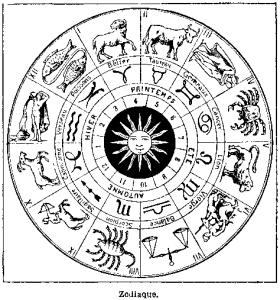
Western tropical Astrology interprets the positions and movements of celestial bodies as meaningful in human affairs. Originating in ancient Mesopotamia (c. 3000–2000 BCE) it developed into distinct traditions, including Western and Chinese astrology. Using structured systems of planets, signs and cycles, it offers symbolic frameworks for interpreting personality, events and possible futures. In Western astrology, the zodiac is divided into twelve signs of 30 degrees each, forming a circle of 360 degrees.
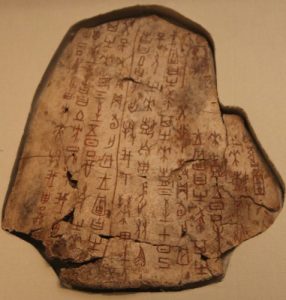
Chinese oracle bones used during the Shang dynasty (c. 1600–1046 BCE), were inscribed with questions about warfare, harvests, health and royal affairs. Heat-induced cracks were interpreted as answers from ancestral or divine forces, sometimes recorded alongside the questions.
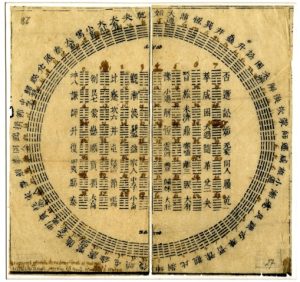
The I Ching The Book of Changes (1000–750 BC) is organised around 64 hexagrams, each formed from six broken or unbroken lines. The twelve Sovereign Hexagrams provide a traditional way of representing the changing balance of yin and yang through the months and seasons.
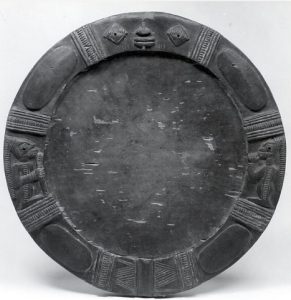
The Yoruba Ifá divination system (c. 1100 BCE) uses 256 Odù figures formed from combinations of binary signs. Diviners interpret these through an oral literature of verses, stories and proverbs, drawing on accumulated cultural knowledge to address questions about human experience, decisions and destiny.
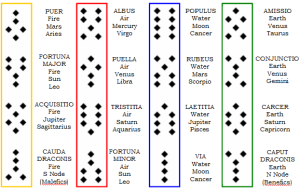
European geomancy developed from the Arabic Islamic world as ʿIlm al-Raml (‘the science of the sand’) (c. 900 AD ) and spread through Europe during the medieval and Renaissance periods (1200 AD). It uses 16 figures formed by counting randomly made dots. Diviners interpret these figures to answer questions and predict possible outcomes, turning chance patterns into a structured system of meaning.
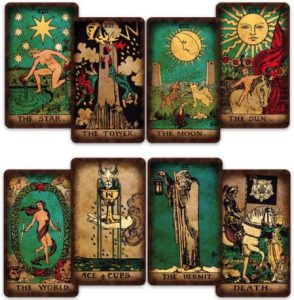
Tarot has a Major Arcana consisting of 22 cards, each associated with particular symbols and themes, along with other cards in the deck. Their meanings depend on the interpretive tradition, the reading and the relationship between the cards. Tarot began as a Renaissance court game tarocchi (1440 AD), with divinatory use developing centuries later (1750 AD).
People naturally project meaning, archetypes, and narrative onto systemic play. Who knows which games we play now will become the divination rituals of the future?
Consulting an oracle can be understood as asking a question of one of these structured symbolic systems. The resulting signs, patterns or texts do not necessarily provide a single, definitive answer. Their meaning emerges through interpretation, whether by a trained practitioner or by the person asking the question.
COMPARATIVE ARCHITECTURE OVERVIEW
| Feature | Ancient Oracle Engine | Modern AI Engine |
|---|---|---|
| Input Method | Casting lots, coins or bones, recording birth times. Random marks, numbers or objects generate a pattern | Text Prompt, tokenised input. Probabilities and token selection generate a sequence of words |
| Data Structure | 12 Houses, 64 Hexagrams, 256 Odù (Fixed Symbolic Arrays) | Multi-dimensional Vector Spaces (Embeddings) |
| Processing | Archetype Wheel / Priesthood interpretation | Neural Networks / Attention Mechanisms |
| Output | Contextual Myth, Allegory, and Behavioural Prescriptions | Synthesised Text, Code, and Probabilistic Solutions |
Incidentally, Leibniz developed binary arithmetic in the seventeenth century. In 1701, he received a diagram of the I Ching’s 64 hexagrams from the Jesuit missionary Joachim Bouvet and recognised their correspondence with binary numbers. The Yoruba Ifá divination system arrived at binary independently.
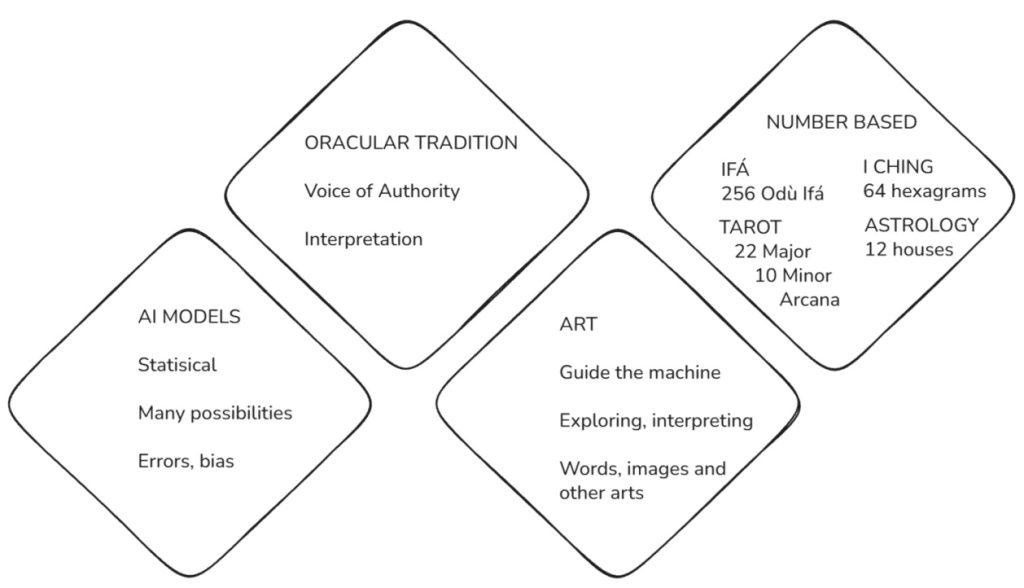
The artist, like the priest or oracle, interprets something that is not immediately understood. Prompt engineering is therefore more than a technical way of getting results from AI. It can also be a skilled creative act, involving intuition, experimentation and interpretation.
In ancient times, priests interpreted the signs of an oracle, whether cracked bones, the stars or cryptic verses, and explained what they might mean for human life.
Artists working with technology and generative or conceptual systems do something similar. They use prompts, rules and other controls to guide the process, exploring its possibilities and turning unpredictable outputs into images, words and other forms of art.